
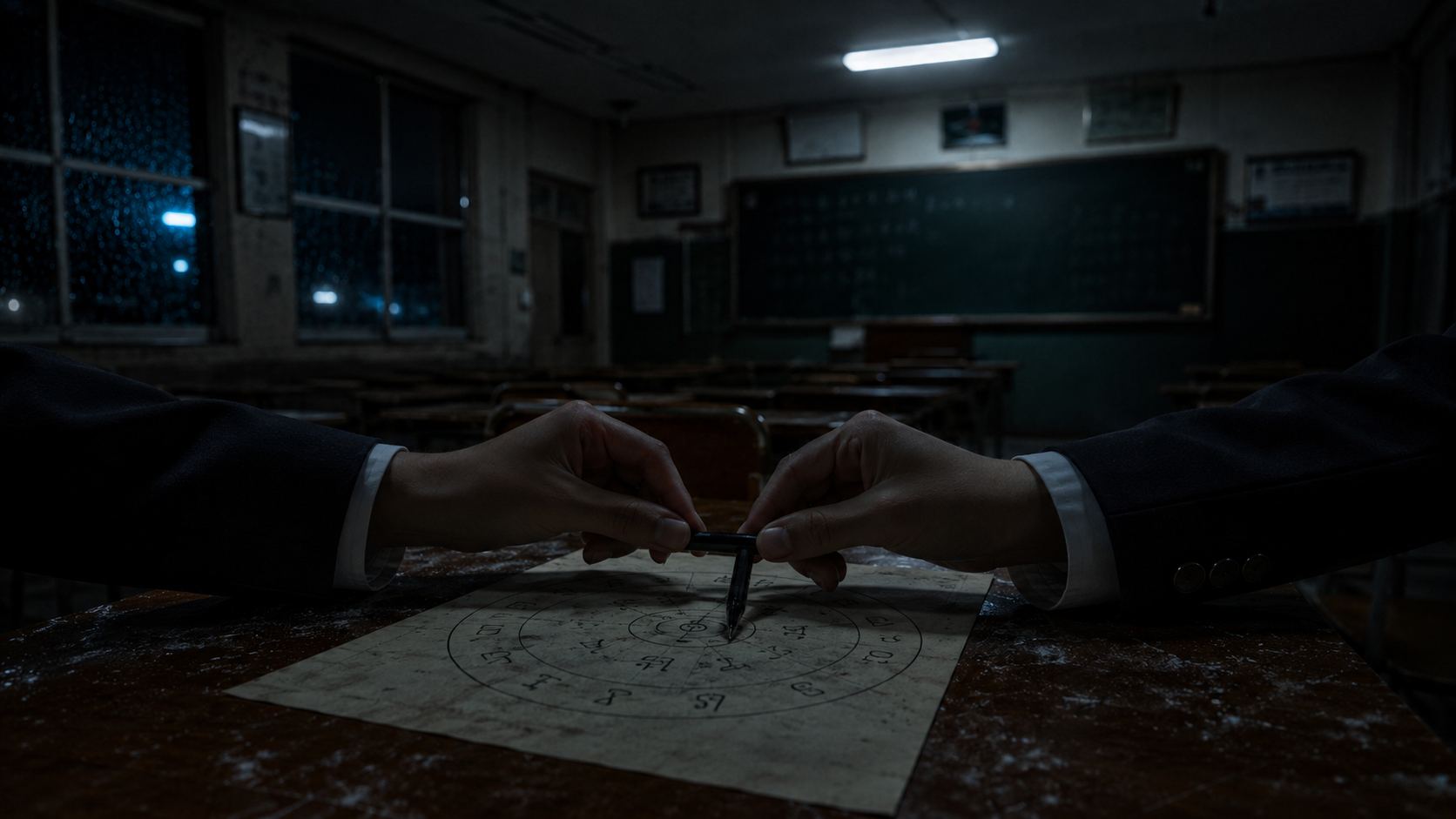
A classroom where we held a single pen together and called upon a spirit through Bunshinsaba.
We did not turn off all the classroom lights.
We left just one row of fluorescent lights on.
Outside the window, it was already dark, and from the hallway we could occasionally hear kids from other classes talking.
There was a single sheet of paper on the desk.

In the center was a circle.
Around it were numbers and letters.
On one side was Yes.
On the other side was No.
And one pen.
Two people held that pen together.
“Bunshinsaba, Bunshinsaba.”
If someone laughed first, the mood broke.
Still, we tried again.
We lowered our voices even more.
“Oide kudasai.”
Spirit, please come.
After those words ended, the classroom became strangely quiet.
No one knew whether a ghost had really come or not.
But if the pen moved even a little, it was no longer a joke.
Who pushed it?
You put strength into your hand, didn’t you?
No, I really didn’t move it.
Even the kids who had been laughing closed their mouths at that moment.
When Cine21 introduced the 2004 film Bunshinsaba, it described Bunshinsaba as “an incantation used to summon a ghost.” The article explained that when two people hold a pencil together and place it on a sheet of paper, the pencil moves in response to the chant and is said to deliver the ghost’s story. It also noted that the chant was known to have come from Japan, and that it had long enjoyed secretive popularity, especially among girls’ schools.
The reason Bunshinsaba was frightening in Korean schools was simple.
The things you needed were too easy to prepare.
You did not have to go to an abandoned house.
You did not have to walk along a mountain path at night.
All you needed were two friends, one sheet of paper, and one pen.
That was the problem.
You could do it during recess.
You could do it during evening self-study.
You could do it inside a room on a school retreat.
You could do it in an empty classroom after school.
When adults told you not to do it, it only made you want to do it more.
Bunshinsaba always came with similar taboos.
You must not let go of the pen in the middle.
You must not do it alone.
You must not summon it as a joke.
You must not ask strange questions just to check whether it has arrived.
You must send it back properly at the end.
The problem was that children were never going to follow those rules properly.
Someone deliberately moved the pen.
Someone insisted they had not moved it.
Someone suddenly let go.
Someone said the name of a dead person just to scare a frightened friend.
From that moment on, the atmosphere changed.
At first, everyone laughed together.
Then one person became quiet.
And then someone said it.
“But didn’t it really move earlier?”
Once those words came out, it was over.
With Bunshinsaba, what came afterward was scarier than the ghost itself.
The walk home.
Lying down after turning off the lights.
Going to school the next day and finding that the friend who had done it with you was absent.
Even while thinking it made no sense, it still bothered you.
The Bunshinsaba ghost story also became widely known through film.
The 2004 film Bunshinsaba, directed by Ahn Byeong-ki, tells the story of a bullied female student who recites the chant to curse the children who torment her, after which a series of mysterious deaths follows. The Kyunghyang Shinmun introduced the film as “a horror movie about bullying and a vengeful spirit.”
Lee Jong-ho’s novel Bunshinsaba, which is connected to the original work, touches on similar points.
According to the YES24 book description, the work moves beyond the closed space of a school and uses an isolated village as its setting, dealing with the superstition popular among students and the issue of bullying. It tells the story of Yu-jin, who transfers to a rural school, is ostracized by her classmates, and sets events in motion by cursing them with the Bunshinsaba chant.
That is why Bunshinsaba was not just a ghost game.
The feeling of hating someone at school.
Resentment that could not be put into words.
An atmosphere that began like a joke but could not remain a joke until the end.
All of those things gathered at the tip of the pen.
Of course, there is no evidence that a ghost actually moved the pen.
Most cases can be explained by pressure in the hands, a friend’s prank, expectation, and nervousness.
When two people hold the pen at the same time, it becomes unclear who moved it.
Someone may have put strength into their hand without even realizing it.
But in the classroom, explanations like that did not work very well.
Children looked at each other’s faces before they thought scientifically.
You moved it, didn’t you?
No, I didn’t.
Then who moved it?
When there was no answer, a ghost entered that empty space.
That is also why Bunshinsaba remains so memorable.
The Hong Kong Grandmother Ghost comes from outside.
The Red Mask is encountered on the street.
The Bongcheon-dong Ghost approaches from inside a screen.
But Bunshinsaba is different.
I called it.
I held the pen with my own hand,
I spoke the chant with my own mouth,
and I asked questions because I was curious.
That made it feel even more unsettling.
It was not a story about something frightening happening to you.
It left behind the feeling that you were the one who had started it for no good reason.
One row of fluorescent lights left on in the classroom.
Yes and No written on the paper.
A pen held between a friend’s fingers.
And voices that had grown lower for no reason.
“Bunshinsaba, Bunshinsaba.”
Those words began as a trivial joke.
But the moment the pen moved even slightly,
the children knew right away.
They knew this was something they would never know, to the very end, who had moved it.

